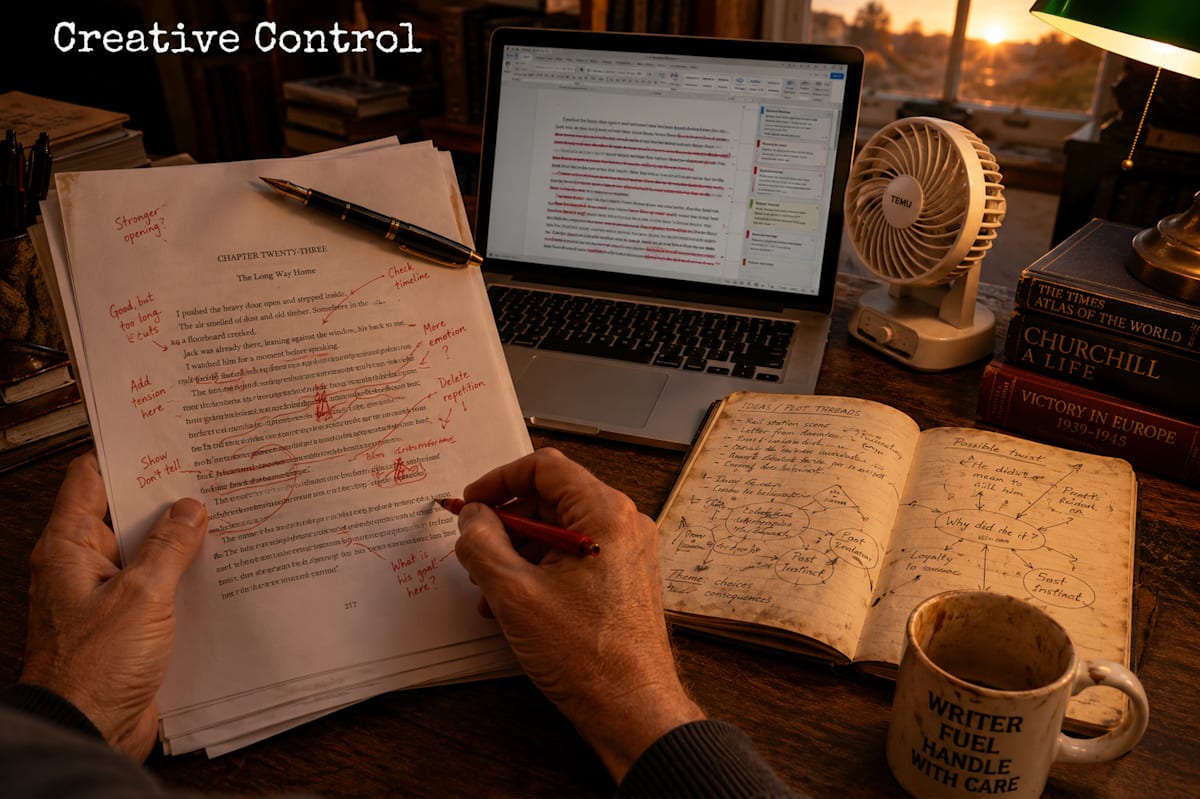
A small plastic battery-powered fan from Temu has been playing tricks on me. It sits on my desk, next to my keyboard, close to my computer screen, blowing cool air to sooth my fevered writer's brow.
Twice now I've looked away from my desk, only to find, when I look back, it pointing in a different direction. Being a writer, my first thought was that something unseen had decided I needed cooling from a different angle. Maybe a poltergeist. That would be cool in a very different way. But being a science geek, my second thought was harmonic vibration, resonance and a cheap plastic base.
Reluctantly, Mr Geek won.
But it did get me thinking.
Not about fans.
About writing.
For many writers, these days there seems to be an invisible line in the sand. If I said I had hired a ghostwriter to write my next novel, most people wouldn't even shrug their shoulders. As long as I was honest about it, most readers probably wouldn't lose any sleep. Even if I wasn't honest about it, most readers wouldn't care. To them, it's the story that matters, not the writer. Ironically, it's often within the writing community that the strongest objections are raised
If I said I'd used Grammarly to improve my grammar, nobody would bat an eyelid. If I said I'd used Microsoft Copilot to rewrite a few clumsy sentences, I doubt many readers would even care. But if I say I use AI while writing my books, suddenly the conversation changes. Out come the pitchforks, the cries of "That's not real writing!" and the assumption that I've pressed a button while a computer has done all the work.
The reality, at least for me, couldn't be further from the truth.
I admit I've experimented. I've asked AI to research historical events. Sometimes it's useful. Sometimes it's hopelessly wrong. I've asked AI to write a chapter more than once. It invariably decides that my characters would be happier living somewhere else, saying things they've never said, and behaving like complete strangers. I even had one character move from England to France during an invasion. It can actually create more work because every sentence has to be checked. But sometimes AI can come up with the kernel of an idea that actually works. That's no different than an editor doing the same thing. Or an editor insisting I rewrite a chapter, paragraph or sentence.
AI is useful, frustrating, occasionally inspiring, and frequently wrong. What it produces is never something I would publish unchanged. What it does produce is ideas. Sometimes good ideas, sometimes ludicrous ideas, but ideas nonetheless. And occasionally it can rephrase a sentence in a way I hadn't considered. It can take my idea in a direction I hadn't explored, or remind me exactly why my original version was better.
Then I rewrite it. And rewrite it again. And during the editorial process and read through I rewrite it again, and again, until by draft eight or nine, it's so very different from the original. If that process sounds familiar, it should, because writers have always bounced ideas off other people and rewriting those ideas until it reads just so.
Editors suggest changes.
Proofreaders find mistakes.
Beta readers point out plot holes.
Friends ask awkward questions.
Spouses tell us a character doesn't ring true.
None of that makes the book any less ours.
So where is the difference? Perhaps the real question isn't whether we use AI, perhaps it's all about who remains in control. The story begins with my imagination. The characters are mine. The plot is mine. The historical research is mine or thoroughly checked by me. Every suggestion is accepted or rejected by me. Every chapter is rewritten until it carries my voice rather than anybody else's.
That's called editing.
Or perhaps it's simply called writing.
Tools have changed throughout history. The typewriter didn't replace the author. Neither did the word processor. Spell check didn't make writers obsolete. Neither did grammar software.
AI is simply another tool. A powerful one, certainly. An imperfect one, definitely. But still only a tool.
The danger isn't AI. The danger is surrendering creative control.
As long as the author remains the person making the decisions, choosing the words, shaping the story and taking responsibility for the finished work, I struggle to see the problem. Readers don't fall in love with the tool that created a story. They fall in love with the story itself.
Perhaps that's the only question that really matters.
Who was in control? Creative control is the difference between using a tool and being used by one. And for me, the answer is simple.
The fan may occasionally decide which way it's pointing.
My stories never do.
Copyright © Tom Kane 2026