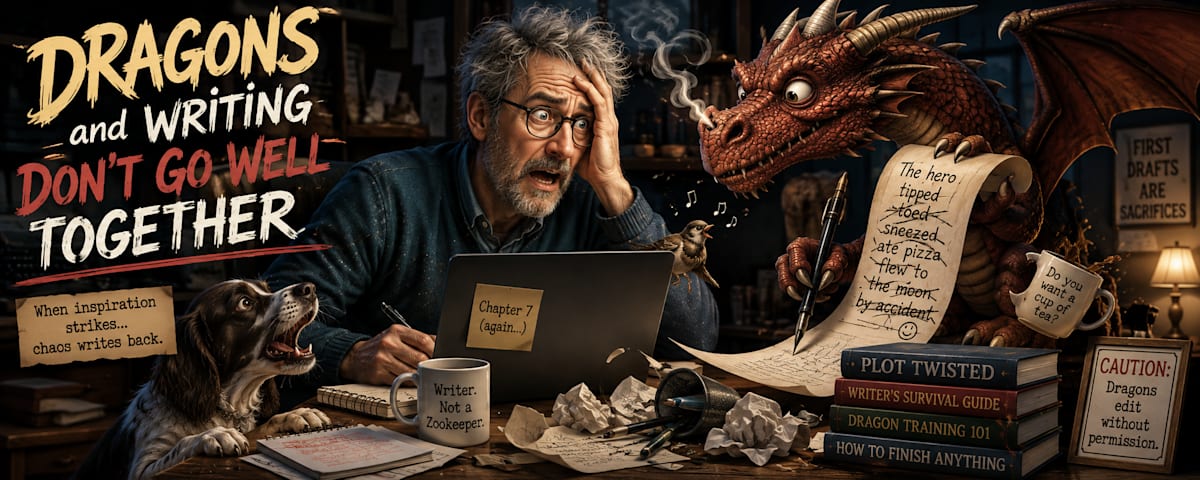
At some point in my writing career, I decided typing was inefficient.
This was obviously ridiculous.
I had been typing perfectly happily for years, but technology had provided me with an exciting alternative.
Dragon voice recognition software.
The idea was magnificent.
Instead of sitting at a keyboard laboriously typing thousands of words, I could simply speak my novels.
I would stroll around the room like Charles Dickens, dictating glorious prose while the computer obediently recorded every word.
Productivity would soar.
Novels would practically write themselves.
I bought Dragon.
That was my first mistake.
Before Dragon could transform my spoken brilliance into literature, it had to learn my voice.
This seemed reasonable.
I have an English accent. Dragon was software. We merely needed to become acquainted.
So I read things aloud.
Dragon listened.
I read more things aloud.
Dragon listened harder.
Eventually, the software announced that it understood me.
This was a lie.
Nevertheless, I opened a document and prepared to dictate.
"The man walked slowly towards the door."
Words appeared on the screen.
They were not those words.
I tried again.
"The man walked slowly towards the door."
A completely different sentence appeared.
Apparently, the man was no longer walking towards anything and may have become agricultural machinery.
I corrected Dragon.
We tried again.
Progress was made.
Then a bird chirped outside.
Dragon typed something.
I stopped.
The bird chirped again.
Dragon had another go.
I don't know what language the bird was speaking, but Dragon appeared considerably more confident about understanding it than it was about understanding me.
At this point, my dog barked.
Dragon typed something else.
This was becoming interesting.
I spoke.
The bird chirped.
The dog barked.
Dragon faithfully attempted to transcribe the entire conversation.
My novel was rapidly developing a subplot I had not anticipated.
I continued dictating.
The dog barked again.
I muttered something under my breath.
Dragon typed that as well.
I deleted it.
Dragon misunderstood the deletion command.
I said something considerably less polite.
Dragon understood that perfectly.
Technology is like that.
Then came the final blow. From somewhere else in the house came a voice.
"Do you want a cup of tea?"
Dragon typed it.
Right into the middle of my novel.
My protagonist had been creeping through a darkened building, possibly carrying a gun, while an unseen killer waited somewhere ahead.
And suddenly:
"Do you want a cup of tea?"
To be fair, it was a very British interruption.
I stared at the screen.
The dog stared at me.
The bird continued contributing editorial suggestions from outside.
Dragon waited eagerly for further instructions.
I made a decision.
"Yes."
Dragon typed that too.
I eventually discovered something rather important.
I don't write by speaking.
I write by typing.
The two processes use entirely different parts of my brain.
When I type, I can stop halfway through a sentence, stare into space, change a word, delete three lines, write them again, decide the original version was better, put it back, make coffee and then discover I have forgotten what the sentence was about.
This is called writing.
When dictating, however, I felt compelled to keep talking.
Silence seemed like failure.
So I filled it.
"John walked into the room and... erm... looked around and... well... there was probably a table..."
Dragon happily recorded every dreadful syllable.
At least a keyboard has the decency not to write anything until you know what you want to say.
This happened some years ago, and I am sure modern voice recognition software is vastly better.
Artificial intelligence can now transcribe conversations, recognise different speakers and understand accents with astonishing accuracy.
Perhaps today's Dragon would ignore the bird.
Perhaps it would recognise the dog as background noise.
Perhaps it would understand that "Do you want a cup of tea?" was not supposed to appear halfway through a murder scene.
But I'm not risking it.
I have a keyboard.
It understands me perfectly.
When the dog barks, it does nothing.
When a bird chirps, it remains silent.
When somebody asks if I want a cup of tea, it patiently waits while I answer.
And when I mumble something unprintable because I've just discovered a plot hole on page 187, it has the good sense not to record it.
Sometimes technology improves the writing process.
Sometimes the best writing tool is the one that knows when to keep its mouth shut.
As for Dragon?
I eventually stopped using it.
Which was probably just as well.
The dog was starting to demand royalties.
Copyright © Tom Kane 2026