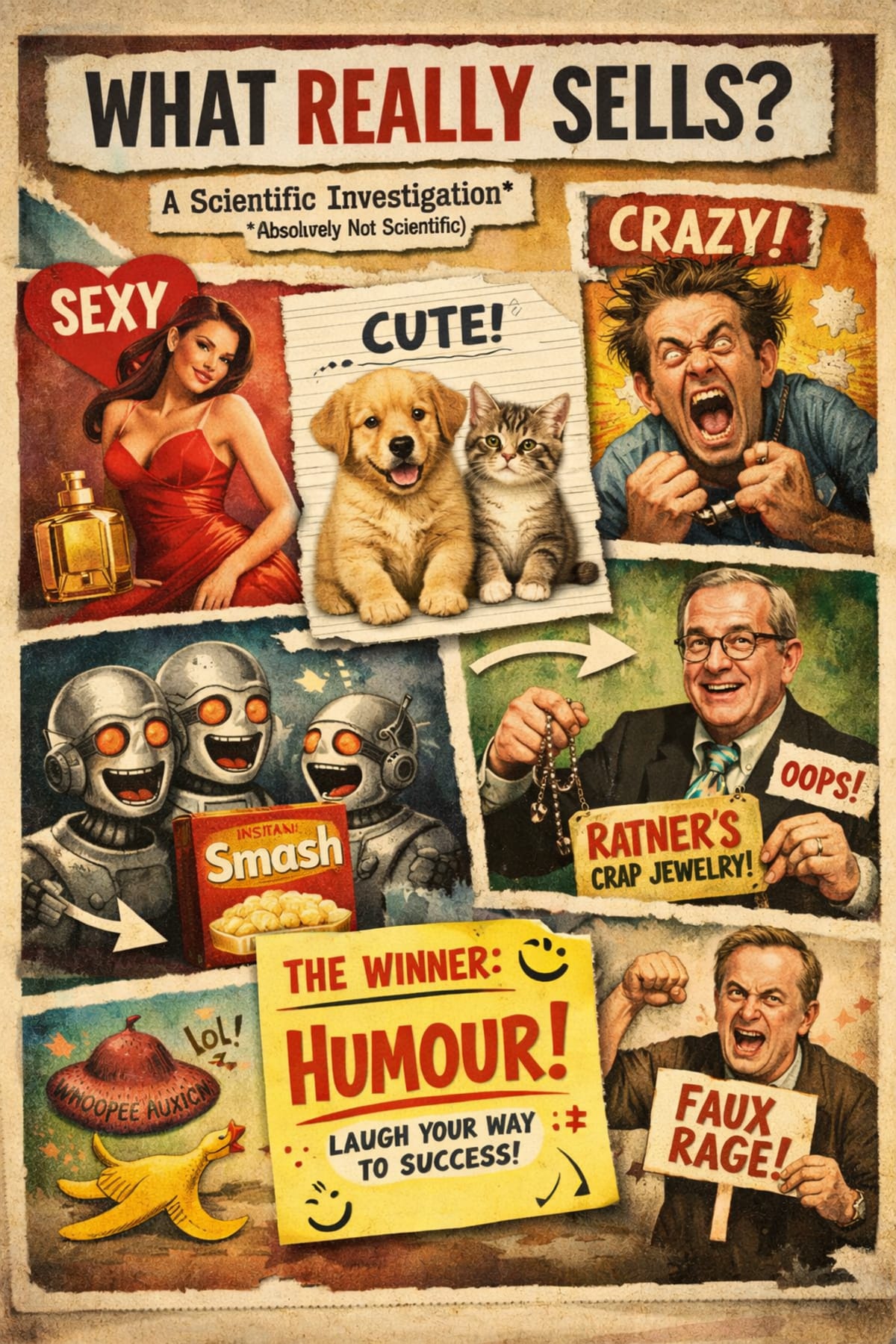
I have spent the last few months conducting what can only be described as deep market research. Not with spreadsheets or focus groups, you understand, but by watching the internet very carefully while drinking coffee.
Why? Because I am an indie author, and indie authors are, by necessity, part writer, part publisher, part marketer, and part slightly bewildered Victorian inventor muttering, “If I just turn this lever…”
Like every author who has ever stared at an empty sales dashboard, I wanted to know the secret. What actually makes people stop scrolling, look up, and think, Oh, that’s interesting?
The internet, it turns out, has a fairly small menu.
Sexy people
Sex sells. This is not news. It has been known since at least the invention of the fig leaf.
However, it is very much dependent on the product. A glamorous woman selling perfume makes sense. A sculpted man advertising aftershave, watches, or fast cars also tracks logically. We accept the shorthand. “Buy this, and some of this glamour may rub off on you.”
Try bolting the same image onto, say, insurance, plumbing services, or a historical novel set in 1940s France, and the result is confusion rather than conversion.
People do not look at a sultry pose and think, Yes, that is exactly the emotional tone I want from a book about wartime espionage. Context, as it turns out, matters.
Cute puppies and kittens
Ah yes. The nuclear option.
Cute animals are the internet’s universal solvent. They dissolve cynicism, resistance, and occasionally dignity. A puppy tilting its head can sell almost anything, including things the puppy itself clearly does not understand.
Almost.
The trick is suitability. Puppies work brilliantly when the product is already warm, friendly, or domestic. They are less effective when selling enterprise software, legal services, or anything involving existential dread.
No one has ever looked at a kitten and thought, Yes, now I am emotionally prepared for a bleak meditation on time, loss, and causality.
If they have, they probably need help.
Humour
This is where things get interesting.
Humour works across almost every category. It disarms. It invites. It lowers the psychological drawbridge.
One of the most famous examples is the Smash advert from the 1970s, in which alien robots laugh themselves into metallic hysterics at the idea that humans once made mashed potatoes by hand. No sex. No puppies. Just robots mocking us for our own inefficiency.
And it worked.
Why? Because humour creates a shared moment. The audience feels clever for getting the joke, included rather than targeted. You are not being sold to. You are being entertained, and the product just happens to be standing there when the laughter dies down.
As an author, this is gold dust.
Anger (with a safety catch)
Anger can work, but only when it is wearing a comedy hat.
Real anger makes people defensive. Faux anger, exaggerated and theatrical, can be oddly compelling. It gives energy without hostility. Think less “furious man shouting at camera” and more “exasperated person pointing out the obvious with raised eyebrows”.
The moment anger turns sincere, the spell breaks. People do not want to buy things from someone who appears genuinely cross with them.
Life is already quite cross enough.
Crazy people doing crazy things
There is a persistent belief in advertising that randomness equals memorability. This is how we end up with adverts featuring people shouting, dancing inexplicably, or behaving like they have just licked a battery.
It does get attention. Unfortunately, it also tends to overshadow the product entirely. People remember the chaos, not the brand.
If viewers finish by saying, “Well that was odd,” but cannot tell you what was being advertised, the campaign has failed, however loudly it failed.
Truth and honesty (the dangerous kind)
Truth can be powerful, but it must be handled carefully. The cautionary tale here is Gerald Ratner, who famously described his own jewellery as “total crap” during a speech. It was honest, amusing, and catastrophic.
The audience laughed. The shareholders did not.
Honesty works when it builds trust, not when it undermines the entire premise of what you are selling. There is a difference between self-aware humility and pulling the rug out from under your own feet.
So what actually wins?
After months of observation, testing, and muttering to myself like a man who has spent too long online, the conclusion is this:
Humour wins.
Sex comes a close second, but only when it belongs there. Cute animals are powerful but situational. Anger must be fake. Chaos rarely helps. Honesty must know when to stop talking.
Humour, though, travels well. It works across platforms, across products, across attention spans. It suggests confidence. It suggests humanity. It says, We are both in on this.
For an indie author, that is everything.
Now, if you will excuse me, I have a book to write. The marketing robots can wait.
Copyright © Tom Kane 2026