There was a time when ordering a steak was a simple affair.
Rare. Medium. Well done, if you were feeling reckless.
Those days, it seems, may be numbered.
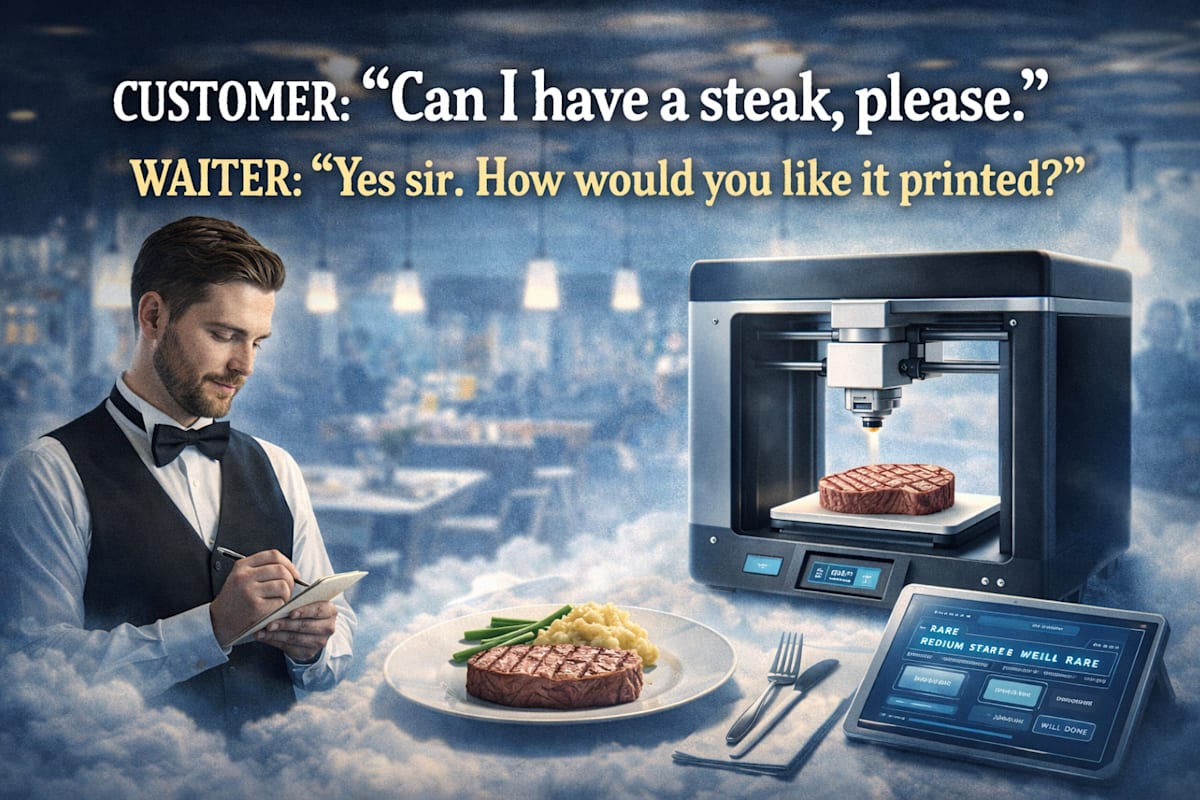
With the news that scientists have successfully produced beef steak using a 3D printer, I can’t help imagining a future restaurant exchange that goes something like this:
CUSTOMER: “Can I have a steak, please.”
WAITER: “Certainly, sir. How would you like it printed?”
At first glance, this sounds like the opening line of a dystopian novel. But let’s be honest, we’ve said that before. About online banking. About smartphones. About people willingly talking to their watches.
The idea itself is oddly polite. No fields. No herds. No muddy boots at dawn. Just a machine quietly humming in the kitchen, producing something that looks, smells, and tastes like steak, without ever having mooed.
Progress has a habit of arriving this way. It doesn’t kick the door down. It slips in quietly and sits at the table as if it’s always belonged there.
I imagine the waiter continuing.
“Would you like the classic texture, sir, or the heritage fibre option? We also do a grass-fed simulation, though the grass itself has never technically existed.”
There will, of course, be purists. There always are. People who insist that if a steak wasn’t once attached to a living creature, it has no soul. These are often the same people who claim music sounds better on vinyl, coffee tastes better if it’s suffered, and bread should involve at least one emotional breakdown during the kneading process.
And they may have a point. Not about the soul, perhaps, but about ritual. Food has always been more than fuel. It’s story, tradition, memory. Sunday lunches. Barbecues that burn one side and leave the other suspiciously cold. Arguments about seasoning that last longer than the meal itself.
Can a printed steak carry any of that?
Possibly not at first. But then again, neither did frozen peas once, and here we are.
What fascinates me most is not the technology, but the question it raises. At what point does imitation become acceptance? If something tastes right, feels right, and nourishes us just the same, does its origin still matter?
And if it doesn’t, what else might quietly change while we’re busy arguing about whether it should?
One day, I suspect, the novelty will wear off. The menu will simply list “steak”, and nobody will ask how it was made any more than we ask how a microwave works. We’ll just eat, talk, laugh, and complain about the price.
Which, when you think about it, is probably the most human outcome of all.
Still, for now, I rather like the idea of the waiter leaning in and asking, with professional seriousness,
“Would you like that medium rare… or shall I update the firmware first?”
Copyright © Tom Kane 2026