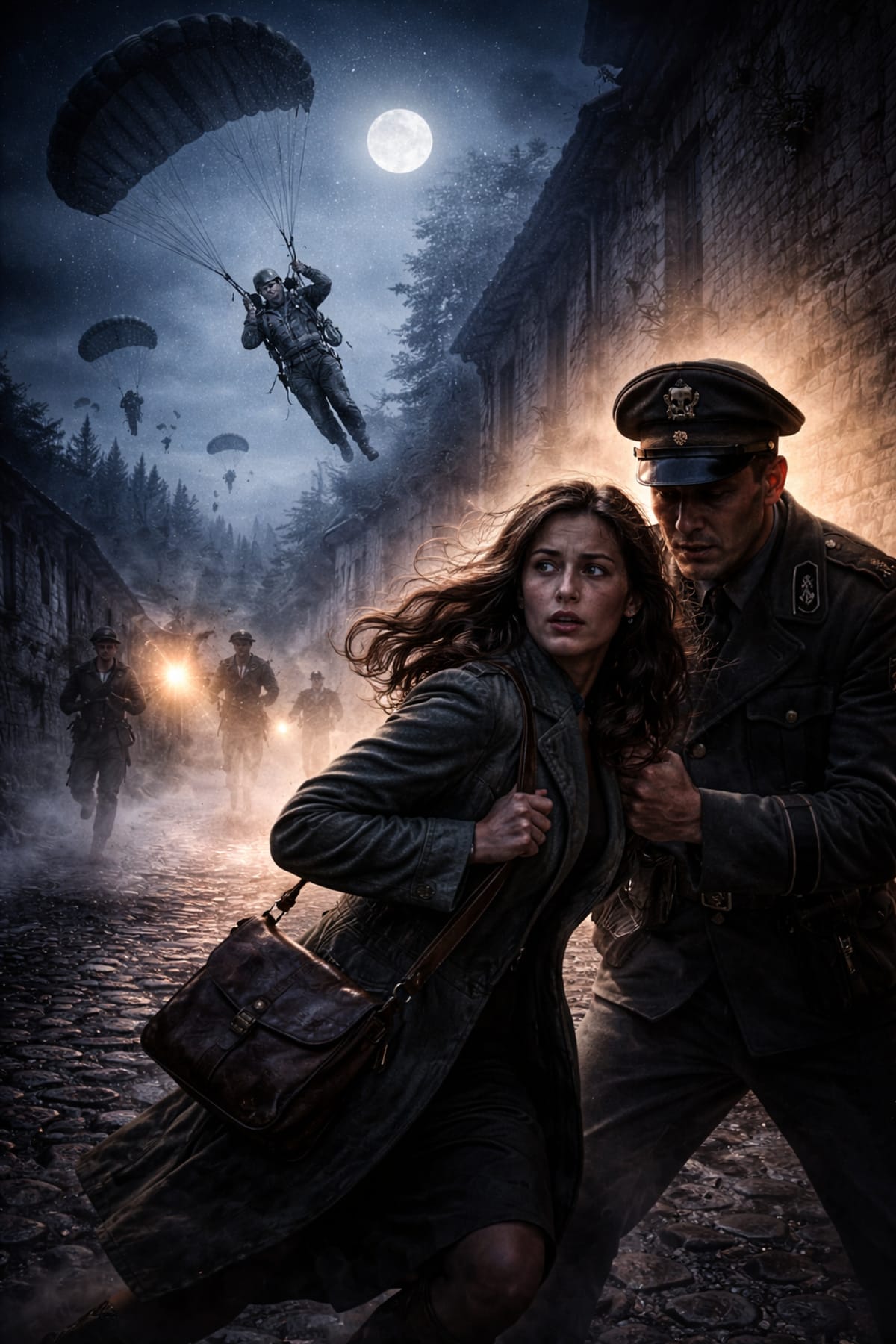
They did not wear uniforms on parade grounds.
They did not march to the sound of brass bands.
They travelled by bicycle along rutted lanes, or walked quietly through market squares, or sat in unlit rooms listening to the faint crackle of a wireless set.
The Special Operations Executive was formed in 1940 with a blunt directive from Churchill: to “set Europe ablaze.” It was an organisation built for sabotage, subversion and resistance inside Nazi-occupied territory. It required secrecy, improvisation and nerve.
And it required women.
Not as decoration. Not as novelty. But as operatives.
Women were recruited because they could move with less suspicion in occupied France. They could cross towns, carry messages, deliver equipment, and observe without immediately attracting attention. They were underestimated by the enemy, and that underestimation became a weapon.
But it would be wrong to imagine they were chosen because they were expendable. They were chosen because they were capable.
The work was not glamorous.
Couriers carried coded messages between resistance cells, often travelling for hours by bicycle with papers hidden in clothing or handlebars. One checkpoint, one poorly timed question, one nervous glance could unravel months of careful preparation.
Wireless operators carried perhaps the heaviest burden. Their sets were bulky and temperamental. Transmission had to be brief, precise and infrequent. German direction-finding vans could triangulate a signal in minutes. Many operators survived in the field for only a matter of weeks before being forced to move or risk capture.
They worked alone more often than not.
Isolation was part of the assignment.
Capture was a constant possibility. Torture was not an abstract threat. It was policy. Several female agents were arrested, interrogated and deported to concentration camps. Some were executed. Others simply vanished into the machinery of war.
The job description did not promise survival.
They volunteered anyway.
Among them were women whose names deserve remembrance. Violette Szabo, who served as a courier in France and was later executed at Ravensbrück. Noor Inayat Khan, a wireless operator who continued transmitting long after her network had collapsed, before being betrayed and killed at Dachau. Odette Sansom, who endured imprisonment and torture yet survived to testify after the war.
Their stories differ in detail. What unites them is moral courage.
They operated without the visible reinforcement of battalions or divisions. Their battlefield was the railway line, the farmhouse attic, the coded transmission. Their weapon was persistence under pressure.
It is tempting, decades later, to romanticise espionage. Film and fiction have draped it in intrigue and allure. But the reality faced by these women was colder, quieter and far more precarious. They lived under false names, trusted sparingly, and knew that discovery would not bring a prisoner-of-war camp with predictable rules.
It would bring something harsher.
Why does their story still matter?
Because it unsettles assumptions. It challenges the idea that war is solely the domain of conventional armies and visible heroics. It reveals how resistance often depends upon those who move unseen. It reminds us that courage does not always announce itself loudly.
It also reminds us that history’s decisive moments often hinge upon individuals whose names rarely make headlines.
The women of the SOE did not fight for recognition. Many fought simply because occupation left them no acceptable alternative. Others crossed borders and dropped into darkness because they believed tyranny should be resisted, whatever the personal cost.
Their bravery was not theatrical. It was deliberate.
And it was real.
The Midnight Series draws inspiration from that quiet, unsentimental courage. It does not present espionage as spectacle. It explores the weight of secrecy, the strain of divided loyalties and the knowledge that some missions may not end with return tickets.
As a novelist writing about this period, I have spent many hours reading first-hand accounts, operational reports and post-war testimonies of SOE agents. The deeper I have gone into their stories, the more I have been struck not by spectacle, but by steadiness. These were not reckless adventurers. They were thoughtful, determined individuals who accepted extraordinary risk in pursuit of something larger than themselves.
The Midnight Series grew from that quiet courage. Jessie Fordham is fictional. The moral weight she carries is not.
You can begin her story here - https://historical-fiction-novels.com/series/the-midnight-series
Copyright © Tom Kane 2026