Today, I became fully digital.
I know this because I have a card to prove it.
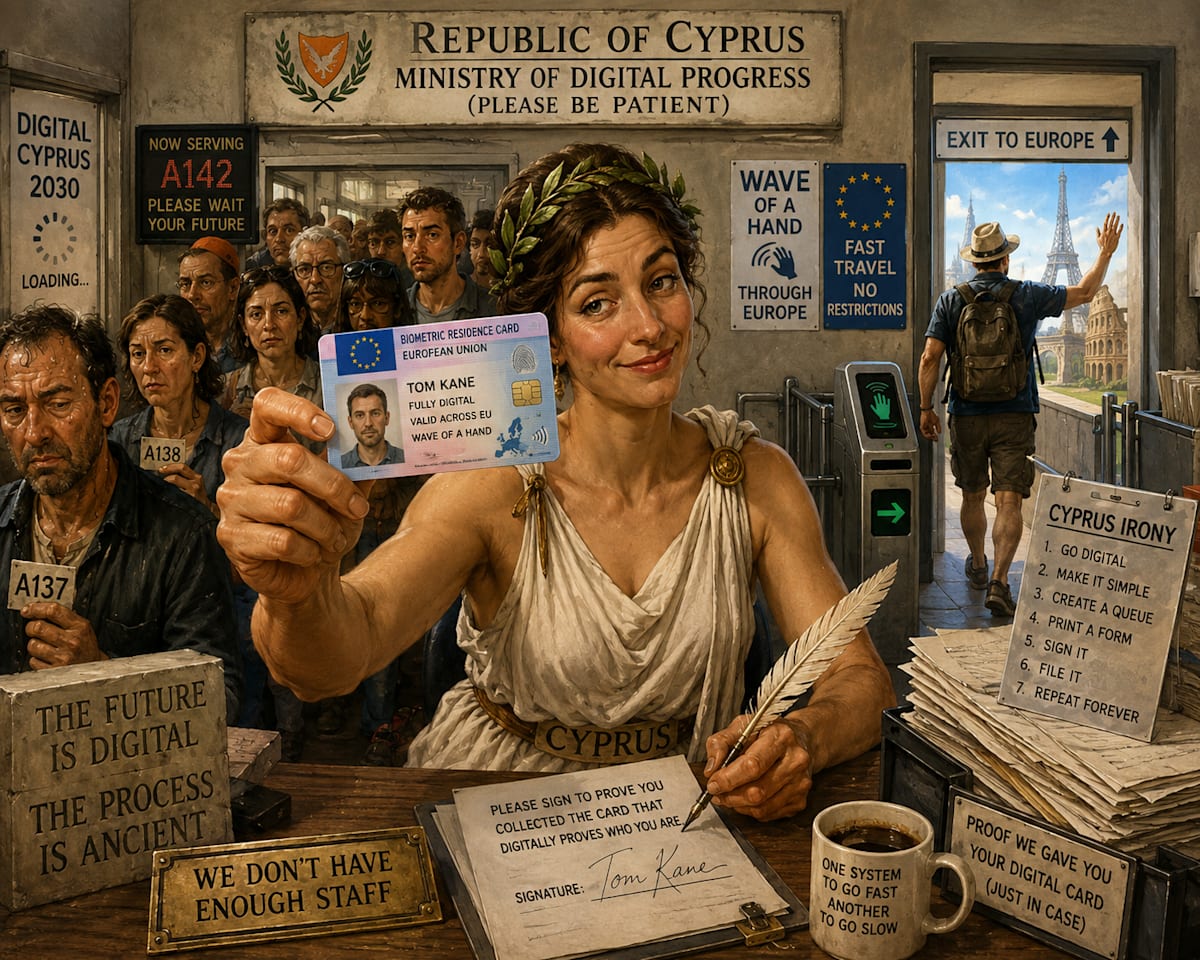
Not just any card, either. This is a biometric card. A small rectangular miracle of twenty-first-century technology containing sufficient information to convince computers throughout the European Union that I am, in fact, me.
Apparently, I can now pass through various bits of Europe with little more than a wave of the hand.
No fuss.
No bother.
No suspicious official staring at my passport photograph before looking at me, then looking at the photograph again, presumably wondering what terrible sequence of events occurred between the two.
I am biometric.
I am digital.
I am the future.
Unfortunately, before I could enter the future, I had to spend an hour standing in a queue.
Welcome to Cyprus government technology.
The immigration office was small, crowded and possessed the sort of atmosphere normally associated with a greenhouse containing several dozen unhappy tomato plants.
There were people everywhere.
People standing.
People sitting.
People leaning against walls.
People staring hopefully at doors.
People staring hopelessly at other people.
And, somewhere at the front of all this humanity, there appeared to be one person actually doing something.
"We don't have enough staff," was the official explanation.
Fair enough. But I had to point out this was my third visit to collect my card. The first time the reception was closed, but the office was open. The second time Old Father Time brushed past me and suggested I come back another day and today was the third time. In fact, the process of applying for the card was faster than the process of collecting the card.
Although I couldn't help thinking this was slightly ironic considering I was there to collect a piece of technology specifically designed to reduce the need for people to do things like queueing.
Still, progress cannot be rushed.
Especially when there aren't enough staff.
Eventually, after an hour of slowly advancing through the sweaty little office, my moment arrived.
I approached the desk.
My biometric card was produced.
There it was.
My gateway to frictionless European travel.
A sophisticated piece of digital identification capable of communicating with equally sophisticated computer systems across national borders.
Machines would recognise me.
Databases would verify me.
Electronic gates would open before me.
The European Union and I had finally entered a glorious technological partnership.
Then the official handed me a piece of paper.
"Sign here."
I looked at it.
There was a brief moment when I wondered whether I had misunderstood.
Perhaps this was some sort of biometric test.
Maybe I was supposed to place my finger on the paper and allow an invisible scanner to analyse my fingerprint.
No.
They wanted a signature.
With a pen... on a piece of paper attached to a grubby clipboard.
So, having waited an hour to collect a digital card containing biometric information capable of proving my identity electronically throughout Europe, I had to prove I had collected it by writing my name on a piece of paper.
Somewhere, I suspect, there is now a filing cabinet.
Inside that filing cabinet is a folder.
Inside that folder is my piece of paper.
And one day, should the entire European biometric identification network collapse, somebody will open the filing cabinet, find my signature and announce:
"Don't worry. We've got him."
But I shouldn't complain.
I have the card.
I am officially digital.
From now on, advanced technology will allow me to travel through Europe quickly and efficiently, without unnecessary restrictions or delays.
I merely have to get out of the immigration office first.
Unfortunately, there's a queue at the door.
Copyright © Tom Kane 2026