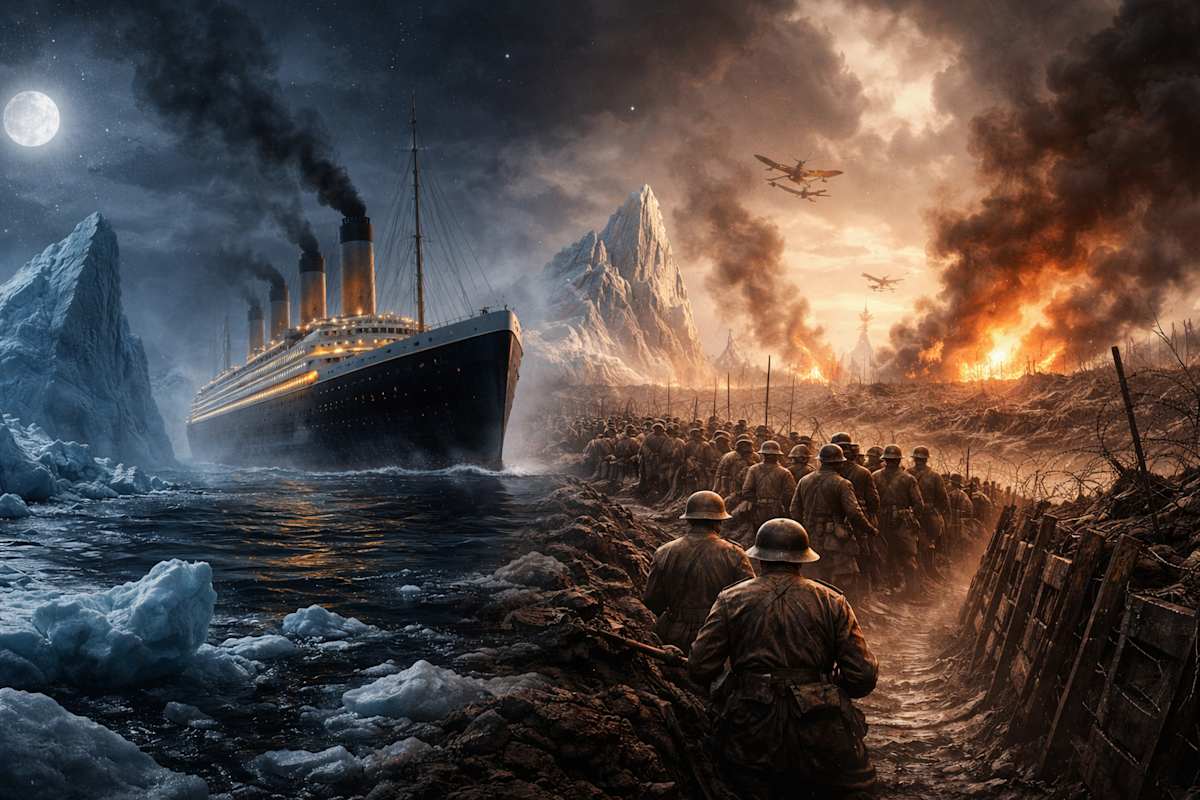
It is easy, with hindsight, to imagine the years before the First World War as a kind of golden afternoon.
Polished silver. Crisp uniforms. Grand railway stations. Edwardian confidence. An empire painted red across the map. A civilisation convinced it had reached a summit of progress and refinement.
The Titanic sailed in 1912, at what many believed was the height of modern achievement. Electric lighting. Wireless communication. Engineering that seemed almost miraculous. The world was shrinking, growing wealthier, more connected. Newspapers carried stories from across the globe within days. Ocean liners crossed the Atlantic in less than a week. The future felt fast.
But what was it actually like to live in that world?
For a small minority, it was elegant. Large houses with servants. Summer seasons. Dinner jackets and gowns. Political influence and financial security. The upper classes lived within clearly defined structures that had changed little for generations. There was comfort in order.
For most people, life was far less polished.
Coal smoke hung in the air of industrial towns. Families crowded into terraced houses. Work was hard, physical and often dangerous. There were no safety nets beyond charity and family. Infant mortality was high. Illness could dismantle a household in weeks. Employment was insecure. Wages were modest. Class boundaries were not theoretical. They were lived realities.
Yet there was also optimism.
Technology seemed to promise upward movement. Railways brought opportunity. Education was slowly expanding. Newspapers were widely read. There was a growing sense that the modern world might, eventually, benefit everyone.
And yet beneath that optimism ran tension.
Industrial unrest was rising. Strikes disrupted coal mines, railways and docks. Workers were beginning to organise with increasing confidence. The suffragette movement was becoming militant. Women chained themselves to railings, endured arrest and hunger strikes, demanding the vote. In Ireland, political tensions over Home Rule were escalating towards something far more volatile.
The surface of society looked composed. Underneath, it was vibrating.
The Titanic herself became a symbol of that era’s self-belief. Advertised as the largest and safest ship afloat, she embodied the conviction that human ingenuity could master nature. Even the class structure of society was replicated aboard her decks. First class travelled in extraordinary luxury. Third class travelled in hope, often emigrating towards uncertain futures.
When she struck the iceberg, more than fifteen hundred lives were lost. The tragedy shocked the world. But the shock was not only about loss of life. It was about the collapse of certainty. The “unsinkable” ship had sunk. The age of unquestioned confidence took on a crack.
And yet even then, few could imagine what was only two years away.
In 1914 Europe walked into war with a mixture of pride and miscalculation. Alliances hardened. Mobilisations began. Within months, the old world was dissolving in mud and artillery fire. The Edwardian calm gave way to trench warfare, rationing, grief and a generation irrevocably altered.
To live through the Titanic era was to live on a threshold.
It was to inhabit a world that felt stable while quietly shifting. A world proud of its industry yet dependent on fragile human systems. A society confident in hierarchy yet restless beneath it. A time of both elegance and anxiety.
That is perhaps why the period continues to fascinate us. It feels recognisable. Modern enough to understand. Distant enough to romanticise. We sense, instinctively, the poignancy of people living ordinary lives on the edge of extraordinary change.
The families who gathered around coal fires in 1912 could not see the trenches coming. The young men boarding trains could not imagine the scale of what awaited them. The women marching for the vote could not yet know how profoundly the war would accelerate social transformation.
History rarely announces its turning points in advance.
In 1912, families gathered around fires, made plans, fell in love, argued over money, dreamed about the future. They believed they were living in modern, stable times.
They were not naïve. They were human.
Within two years, that same world would be unrecognisable.
The Titanic did not end the age. But she reminds us how quickly certainty can sink, and how unaware we often are of the ice beneath our own horizons.
Copyright © Tom Kane 2026
As a historical novelist writing about this period, the research has been a labour of love. The deeper I have gone, the more aware I have become of how precarious that seemingly confident world truly was.
Before the Brittle Sea, my free prequel novella, introduces two of the central characters in The Brittle Saga and begins their journey in that fragile Edwardian moment.
You can download the free novella by clicking here.