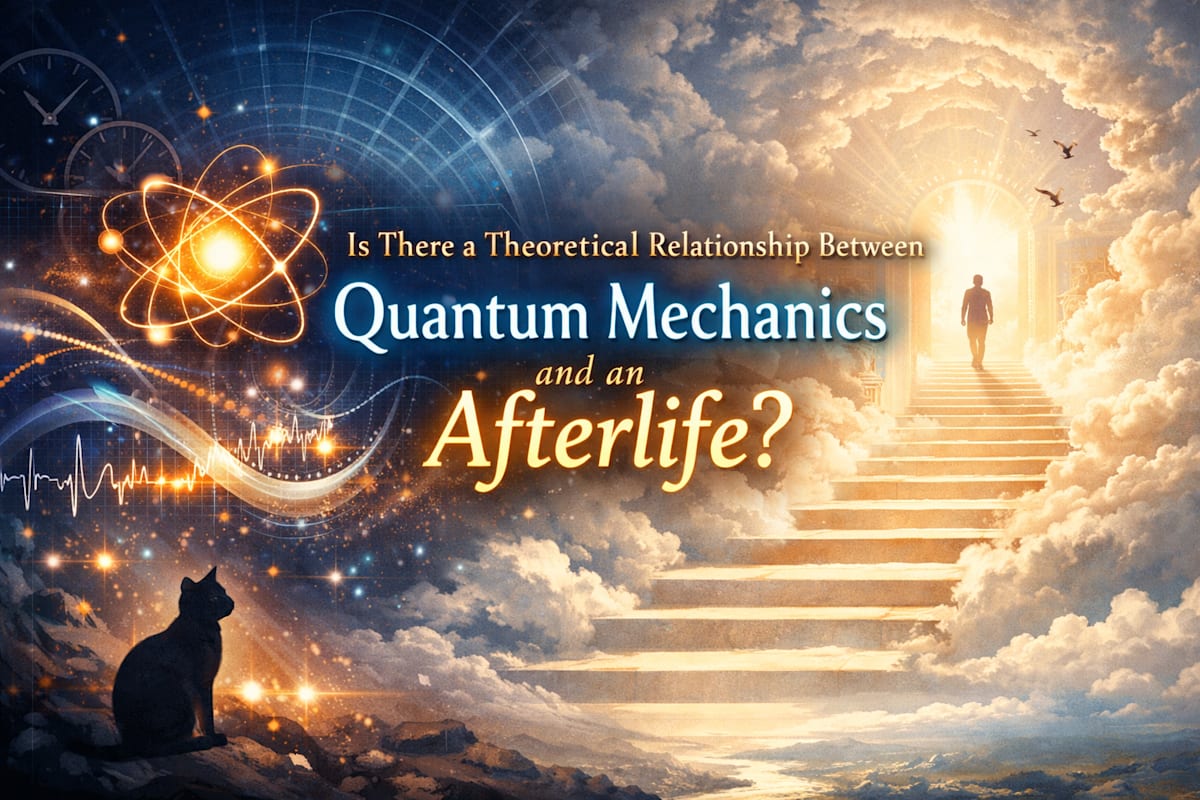
It is a question that sounds as though it should be asked at two in the morning, preferably while staring at the ceiling and wondering where the socks keep disappearing to. Is there a theoretical relationship between quantum mechanics and an afterlife?
The short answer is no.
The longer answer is… well, it is complicated, fascinating, and surprisingly fun to think about.
Quantum mechanics is the branch of physics that politely refuses to behave. Particles can be waves, waves can be particles, things can exist in two states at once, and the act of observing something can change the result. This has caused physicists decades of head scratching, philosophers endless material, and science fiction writers a full-time career.
An afterlife, on the other hand, belongs largely to faith, belief, philosophy, and theology. Religions across the world offer thoughtful, comforting, and deeply human ideas about what might come next. They are not written in equations or probabilities, but in stories, teachings, and meanings. And that is important. Science asks how. Faith often asks why.
Where it gets interesting is in the overlap of imagination.
Quantum mechanics tells us reality is not as solid as it looks. Particles pop in and out of existence. Information seems to matter as much as substance. Time behaves badly under scrutiny. When people hear this, it is tempting to think, “Ah. There must be room in there for something more.”
Physicists, being practical sorts, would gently remind us that weird does not automatically mean spiritual. A quantum field fluctuating does not imply Uncle George is having a nice cup of tea somewhere beyond spacetime. Quantum theory describes what happens to matter and energy. It does not comment on meaning, purpose, or what happens to consciousness after death.
That said, consciousness itself is still a mystery. We know the brain is involved. We know chemistry and electricity play their part. But how subjective experience arises at all remains one of the great unanswered questions. This gap is where speculation creeps in, usually wearing a lab coat it did not earn.
Some people enjoy imagining consciousness as information, and information as something that might persist. Others find comfort in the idea that if the universe is stranger than we thought, perhaps it is also more generous. None of this is proven, and none of it needs to be.
Science does not disprove belief, and belief does not invalidate science. They operate in different rooms of the same house. Occasionally, someone opens a door and peers through, curious rather than confrontational.
Perhaps the healthiest conclusion is this. Quantum mechanics tells us the universe is astonishingly subtle and far from finished revealing its secrets. Faith tells us that human meaning does not end at the limits of measurement. Neither needs to elbow the other aside.
And if there is an afterlife, quantum or otherwise, one hopes it comes with fewer unanswered questions, better lighting, and finally an explanation for where all the missing socks went.
Until then, curiosity remains very much alive.
Copyright © Tom Kane 2026