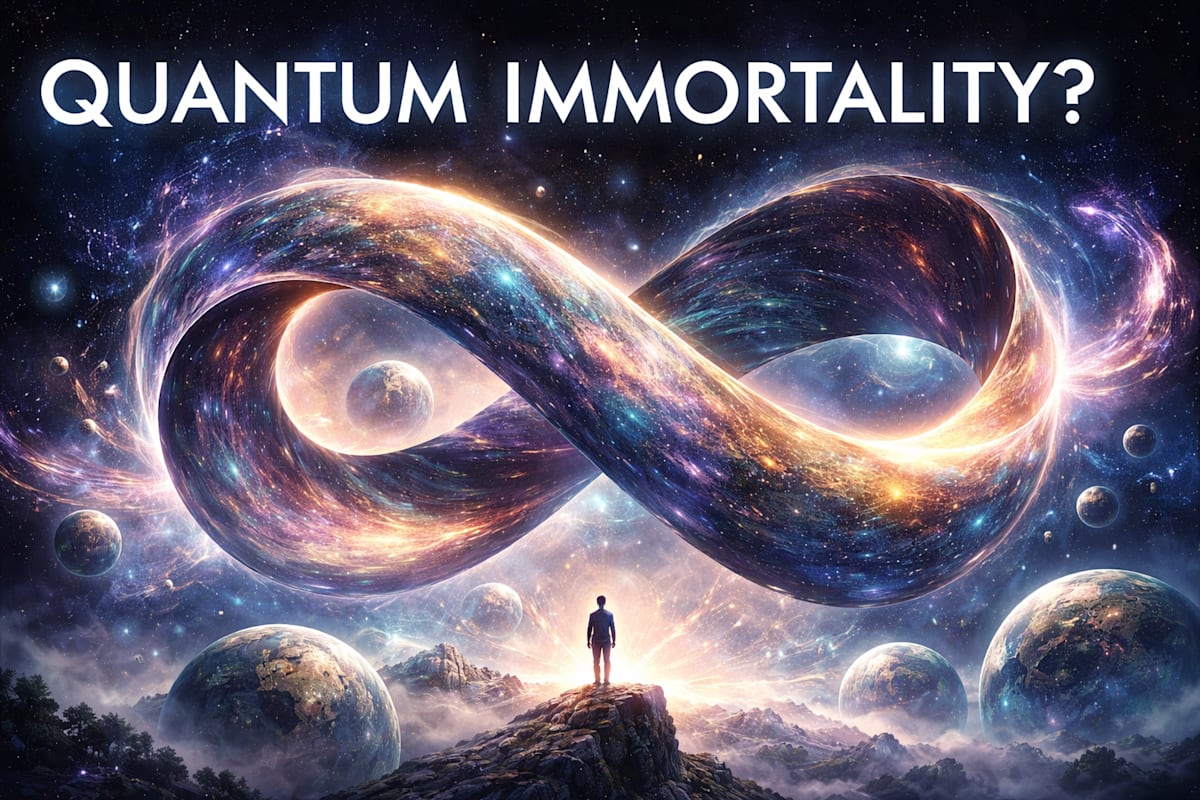
Quantum Immortality
The other day on Twitter, someone asked an entirely reasonable, perfectly sane question:
“Do you think Quantum Immortality could be real?”
Naturally, I replied that I was writing about it in my next novel, The Ragged End of Time. Because if you are going to respond to existential dread, you might as well do it with fiction.
For the uninitiated, Quantum Immortality is the comforting theory that you never actually die. From your own point of view, at least. Every time something fatal happens, your consciousness simply slides sideways into a version of reality where you survived. You never experience death, only increasingly improbable survival.
Which neatly explains why you once walked away from a car accident, a bad illness, or that time you definitely should not have mixed those medications.
According to this theory, there are countless versions of you. Some slipped on the stairs and never got up. Some choked on a biscuit. Some pressed “reply all” to an office email and were quietly erased by reality out of sheer embarrassment.
But you are still here. Congratulations.
Now, add a Möbius strip to the mix.
A Möbius strip has only one side. If time behaves like that, then past and future are not opposites at all. They are the same surface, just experienced from different directions. You are not moving forwards through time, you are looping around it, occasionally passing yourself without making eye contact.
This is where the Spherical Time Hypothesis joins the party.
Instead of time being a line, or even a loop, imagine it as a sphere. Every moment exists simultaneously, like points on the surface of a cosmic beach ball. Birth, death, first kiss, last breath, all happening at once. You are not travelling through time, you are orbiting awareness around a fixed structure.
Which makes free will an interesting suggestion rather than a guarantee.
And then, because things were not complicated enough, along comes the Möbius Superfluid Torsion Engine. A fictional construct, admittedly, but once you have accepted spherical time and quantum survival, it feels rude not to give the universe an engine.
In The Ragged Time Series, this engine is not about speed. It is about orientation. It twists spacetime just enough that consciousness can slide between probabilities. Not jump. Not teleport. Drift. Like oil on water. Or like a thought deciding it prefers a different outcome.
In such a universe, Quantum Immortality is not heroic. It is administrative.
You do not live forever because you are special. You live forever because the system refuses to close your file. Every fatal outcome exists, but awareness keeps being reassigned to the version of you still breathing, still thinking, still wondering why their back hurts this morning.
Eventually, survival becomes increasingly odd. You live to improbable ages. Diseases vanish at the last second. Accidents narrowly miss you with suspicious regularity. Everyone else seems to age normally. You become the statistical anomaly at the centre of your own story.
Which raises an awkward question.
If you never experience death, but everyone else does, are you immortal, or are you trapped?
This is the uncomfortable heart of The Ragged End of Time. Not whether Quantum Immortality is real, but what it would cost psychologically, morally, and emotionally if it were.
Because if consciousness always finds a way to continue, then endings are an illusion. Closure is a myth. And somewhere, in another perfectly valid version of reality, this blog post ended abruptly halfway through a sentence because the author tripped over the cat.
But not in this universe. I don't own a cat in his universe, just a crazy dog called Mad Max.
In this one, you are still reading and I am still writing.
Which suggests, statistically speaking, that Quantum Immortality is doing a very competent job indeed.
Copyright © Tom Kane 2025